How to Order Custom FRP Kiosks and Booths
Define the customer opening, staff workflow, utilities, site access, finish and delivery scope before requesting a custom FRP kiosk quote.
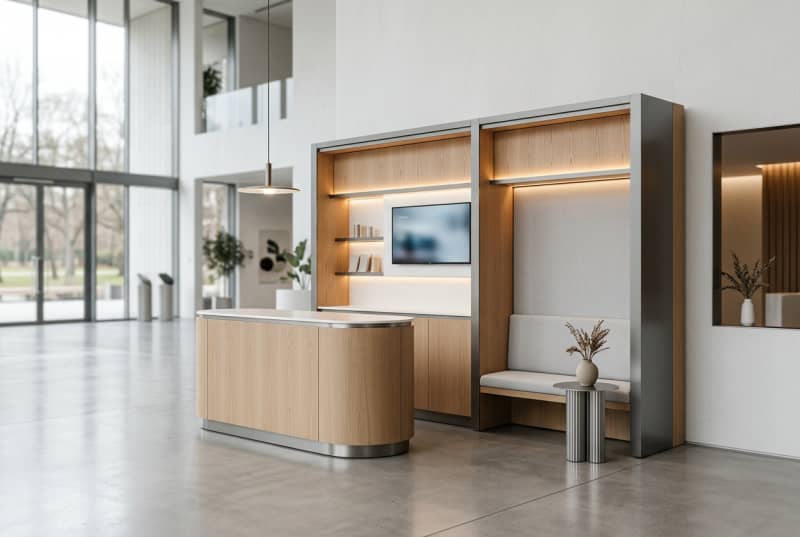
For commercial teams in the United States, custom kiosks and branded booths are no longer niche build-outs reserved for flagship launches. They are now practical infrastructure for retail, food service, public information delivery, transit touchpoints, airport concessions, healthcare navigation, university campaigns, and temporary activations. Buyers are moving away from off-the-shelf units because standard modules often fail in four critical areas: brand consistency, utility integration, operational durability, and compliance fit. A custom structure allows your team to control shape, finish, service windows, accessibility dimensions, storage, power routing, cable management, and modular packing for repeated deployment.
If you are sourcing in high-traffic U.S. markets such as New York City, Los Angeles, Chicago, Houston, Miami, Seattle, Atlanta, or Phoenix, the right kiosk program must account for local permitting behavior, freight lead time through hubs such as the Ports of Los Angeles/Long Beach, Savannah, and Newark, and last-mile delivery constraints in dense urban districts. The faster your concept phase becomes technically specific, the fewer costly revisions appear after engineering sign-off.
This guide gives a complete sourcing framework for branded kiosk and booth projects: product types, manufacturer selection, RFQ readiness, cost control, outdoor design strategy, supplier evaluation, and procurement risk prevention. It also includes practical U.S.-focused tables and planning visuals that teams can use before internal budget approval.
The line chart above reflects a realistic demand progression pattern seen across chain retail retrofits, campus service points, and event-led brand installations. Demand has been driven by experiential retail, self-service integration, and lower tolerance for generic fixtures that cannot represent a brand system consistently across states.
Which Kiosk Types Can Be Customized for Retail, Food Service, Information Points, and Temporary Activations
In practice, most U.S. projects fall into eight customizable kiosk categories. The right category depends on transaction type, service speed, site restrictions, and whether your installation is permanent, semi-permanent, or campaign-based. A well-prepared buyer should classify the project before discussing materials, because configuration determines engineering complexity and final cost more than color or surface decoration.
Teams that need references for specific use cases can review custom structures by function: custom kiosk solutions for general programs, FRP retail pop-up booth configurations for campaign mobility, FRP coffee service booth designs for high-turn foodservice operations, and FRP information booth layouts for public-facing guidance points.
The table shows why customization matters: each category has distinct utility, sanitation, customer flow, and maintenance needs. A single catalog model almost always creates retrofitting costs after purchase.
Industry demand remains broad, with retail and food service leading, but event-driven and public service projects continue to grow due to shorter campaign cycles and the need for movable branded infrastructure.
How to Select a Booth Manufacturer by Branding Goals, Structural Design, Installation Conditions, and Delivery Scope
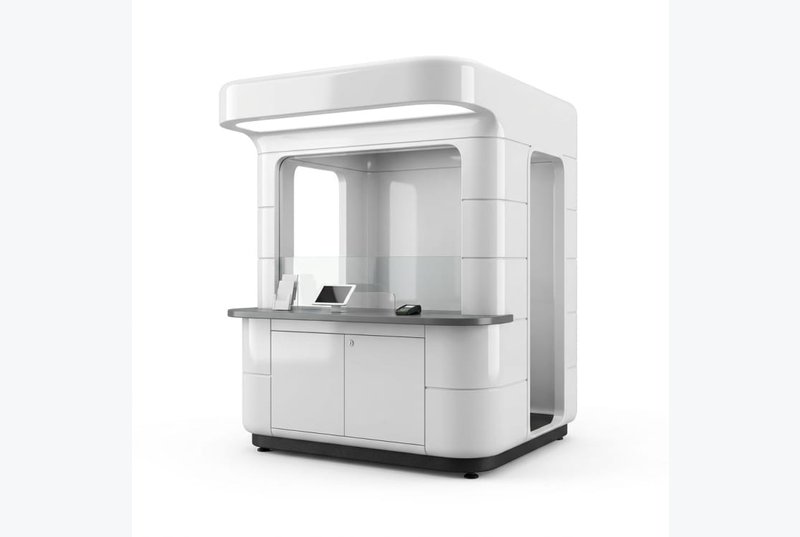
U.S. buyers should score manufacturers across four dimensions: brand execution fidelity, engineering credibility, site adaptability, and delivery responsibility. Many suppliers are strong in visual styling but weak in deployment logistics. Others can fabricate robust structures but lack finish quality expected by national brand teams. The right partner can bridge both.
Branding fit: Request evidence that the supplier can translate guidelines into 3D surfaces, not only flat print panels. Curves, edge transitions, gloss level consistency, and logo illumination tolerances all affect brand perception. Ask for approved color matching process, sample boards, and tolerance standards across multiple production batches.
Structural and technical fit: Confirm internal frame engineering, service access doors, anchoring methods, and load assumptions. If your kiosk includes menu screens, refrigeration, espresso equipment, or ticket printers, ensure early MEP coordination so the shell does not become a conflict point during installation.
Installation condition fit: A kiosk for a downtown Chicago atrium is not engineered like a seasonal outdoor activation in Austin or Miami. Evaluate wind exposure, UV conditions, cleaning chemicals, vandal resistance, and daily open-close frequency.
Delivery scope fit: Clarify whether the supplier is delivering fabricated parts only, pre-assembled modules, installation supervision, full install, permit package support, and post-install maintenance. Cost cannot be compared fairly unless delivery scope is aligned line by line.
This scorecard structure helps procurement teams separate presentation quality from delivery performance. In practice, weighted scoring reduces emotional decisions and supports internal approval with finance, operations, and brand departments aligned.
What to Prepare Before Sending an RFQ for a Custom Kiosk Project to Avoid Delays and Revisions
Most delay cycles begin before RFQ submission. Buyers share high-level sketches, then ask suppliers to quote full scope without site data, utility assumptions, or approval constraints. This forces suppliers to include large contingencies or submit incomplete pricing that later creates change orders.
A strong RFQ package includes design intent, technical constraints, and commercial rules. If your project spans multiple U.S. cities, include jurisdiction differences. A kiosk approved in Dallas may require detail changes in San Francisco due to local accessibility interpretation, fire review patterns, or landlord standards.
The checklist above is practical because it links each RFQ input to a consequence. Teams that implement this structure typically shorten procurement cycles and reduce revision loops after award.
How Materials, Layout, Lighting, and Functional Details Shape the Final Cost of a Custom Booth
Cost forecasting is usually inaccurate because buyers estimate by size only. In reality, the same footprint can vary dramatically in total cost depending on surfaces, complexity of geometry, internal workflow layout, lighting integration, and equipment interfaces. A 150 sq ft booth with complex curves, custom storage mechanisms, and programmable light scenes may cost more than a 220 sq ft orthogonal structure.
The area chart reflects a major shift: U.S. buyers increasingly evaluate lifecycle value rather than only first cost. This trend has expanded adoption of molded FRP systems with reinforced structures that tolerate repeated setup cycles.
Why Outdoor and Semi-Outdoor Booths Need Different Design Rules Than Indoor Promotional Structures
Outdoor and semi-outdoor structures fail early when indoor assumptions are applied. Exposure conditions in coastal states, desert regions, and freeze-thaw climates demand different material specs, joint detailing, hardware grade, drainage strategy, and electrical protection. A booth that looks premium at handover can degrade rapidly if UV, moisture ingress, and thermal expansion are not designed into the system.
For example, a kiosk used in Southern California beachfront locations faces UV stress and airborne salt. A structure in Minneapolis sees freeze-thaw pressure and snow management requirements. A semi-covered kiosk in Houston may encounter humidity spikes and driving rain from storm events. Design decisions must respond to these realities, not generic global templates.
Outdoor and semi-outdoor buyers should also define service intervals in the contract. Preventive maintenance schedules reduce lifecycle cost and keep brand quality stable across seasons.
How to Evaluate a Supplier’s Ability to Balance Appearance, Durability, and Repeated Commercial Deployment
Many suppliers can deliver one attractive showpiece. Fewer can deliver fifty units that still look consistent after freight movement, repeated assembly, and heavy public use. If your program includes national activation tours, temporary city campaigns, or seasonal concessions, repeated deployment capability must be tested before award.
Ask for evidence in three categories:
- Visual consistency under repeated handling: edge wear behavior, scratch resistance, repaint strategy.
- Mechanical reliability: access panel cycle tests, lock and hinge life, caster/bracket endurance where relevant.
- Operational maintainability: spare part availability, standardized replacement methods, modular repair without full disassembly.
In supplier interviews, require case examples with deployment counts, transport distances, and maintenance intervals. A supplier that can discuss real redeployment metrics usually has stronger engineering discipline than one presenting only studio photos.
For buyers prioritizing molded geometry and durable branded surfaces, it is useful to work with teams that manage concept translation into production-ready FRP tooling and repeatable batch output. In our project model, technological capability means converting brand concepts into engineered geometry with controlled tolerance, integrating lighting and service channels into the shell, and validating finish consistency before full production release.
Manufacturing capability is equally important: stable mold management, reinforced structural layering, controlled curing process, and dedicated quality checkpoints for dimensions, surface integrity, and assembly fit. These controls reduce mismatch at installation and preserve appearance across multi-site rollouts.
Service capability closes the loop: structured RFQ consultation, sample and mock-up support, installation coordination, and post-handover maintenance planning. Buyers usually see the biggest value when service scope includes documentation handover, spare strategy, and rapid response protocols for commercial downtime.
Common Procurement Errors in Custom Booth Projects and How Buyers Can Prevent Them Early
Procurement losses are rarely caused by one large error; they are usually the result of small omissions repeated through design, bidding, and execution. Early prevention is significantly cheaper than late-stage correction.
Prevention works best when ownership is clear. Each mitigation action should be assigned to a team and tied to a specific milestone, not left as a general project note.
A Complete Sourcing Guide for Businesses Planning Branded Kiosk and Booth Installations
Direct answer for decision-makers: To order custom kiosks and booths successfully in the United States, define use case and deployment pattern first, select a supplier through weighted technical-commercial scoring, issue a complete RFQ, lock design variables before tooling, and align installation logistics with local site constraints and code pathways.
Industry and application coverage: Leading applications include mall kiosks, airport concessions, university coffee points, municipal information stations, seasonal retail activations, and healthcare guidance pods. Each sector has distinct operating tempo and compliance expectations, so template reuse should be controlled by function families rather than one universal design.
Case pattern 1: Multi-city retail rollout. A brand deploying kiosks in Los Angeles, Dallas, and Boston reduced schedule risk by standardizing the structural core and customizing only front-facing brand skins and digital panels. This approach lowered engineering rework while preserving local campaign flexibility.
Case pattern 2: Event-driven pop-up program. A consumer brand operating across Las Vegas, Orlando, and Chicago improved durability by switching to reinforced molded exterior modules and transport-optimized packing crates. Initial capex increased moderately, but damage-related downtime dropped significantly over repeated deployments.
Case pattern 3: Public information network. A regional operator installed guidance booths near transit and civic venues with anti-graffiti surface strategy, accessible counter heights, and integrated digital wayfinding. Standardized maintenance access shortened service visits and supported consistent public-facing quality.
Local supplier strategy in the United States: Buyers often combine centralized fabrication with regional install support near logistics corridors such as Southern California, Texas triangle markets, the Midwest distribution belt around Chicago, and East Coast networks anchored by New Jersey and Georgia ports. This hybrid model balances production consistency with faster site response.
- More integration of self-service tech: payment, queue analytics, and remote diagnostics.
- Higher policy attention to accessibility and safety documentation quality in public-facing builds.
- Stronger sustainability expectations: lower-VOC finishes, repairable modules, and reusable packaging systems.
- Data-enabled asset management: lifecycle tracking for parts, maintenance cycles, and deployment history.
- Procurement shift toward total cost of ownership instead of first-purchase pricing alone.
The sourcing roadmap is most useful when attached to governance gates. Each phase should have a decision checkpoint and a no-go criterion so unresolved issues do not pass downstream.
Frequently Asked Questions (FAQ)
1) How long does a custom kiosk project usually take in the United States?
For a single moderate-complexity unit, a realistic range is 10 to 18 weeks from concept confirmation to installation. Multi-site rollouts may require 4 to 9 months depending on permitting, utility readiness, and batch sequencing.
2) Is FRP a good choice for branded commercial kiosks?
Yes, especially when you need curved forms, strong finish quality, and repeated deployment durability. FRP systems can be engineered for high-traffic use and can support premium visual expression while remaining structurally practical.
3) What is the best way to control budget without losing brand quality?
Standardize the structural core, limit late geometry changes, define lighting and graphic layers early, and compare suppliers on aligned scope. Focus on lifecycle cost, not only fabrication price.
4) Should we choose one supplier for fabrication and installation?
Often yes, if that supplier has proven site execution capability. If not, a hybrid model can work: centralized manufacturing with regional installation partners under one coordinated project management system.
5) What are the most common causes of schedule slippage?
Incomplete RFQ inputs, late utility decisions, delayed mock-up approvals, and unverified site access constraints are the leading causes. Preventive planning in the first month usually saves the most time.
6) How do we prepare for repeated activations across U.S. cities?
Design modules for transport, specify protective packaging, track assembly instructions by version, and maintain a spare-part kit in regional hubs. Repeatability should be an engineered objective from day one.
7) What should be included in warranty and after-sales terms?
Define coverage by subsystem, response time expectations, exclusions, and spare-part availability. Include preventive maintenance intervals and escalation contacts for operational downtime.
8) How do we choose between indoor and semi-outdoor specs for a covered plaza?
If wind-driven rain, UV exposure, or temperature swings affect the structure, treat it as semi-outdoor and specify coatings, seals, hardware, and electrical protection accordingly.
9) What does procurement need before issuing an RFQ?
At minimum: concept drawings, site data, utility matrix, brand standards, schedule, bid template, and commercial terms. Without these, quote comparison will be unreliable.
10) What makes a supplier scalable for national programs?
Documented quality systems, repeatable manufacturing, logistics planning, installation governance, and reliable post-launch service capability across regions.
If your organization is planning branded kiosk and booth installations for retail, events, or public service in the United States, a structured sourcing model will protect schedule, budget, and brand outcomes. Start with technical clarity, choose on weighted value, and engineer for lifecycle performance from the first RFQ draft.