Custom Composite Quality Documentation: What to Request
Learn which custom composite quality documents matter by risk, from controlled drawings and lot records to inspection, deviations, and packing evidence.
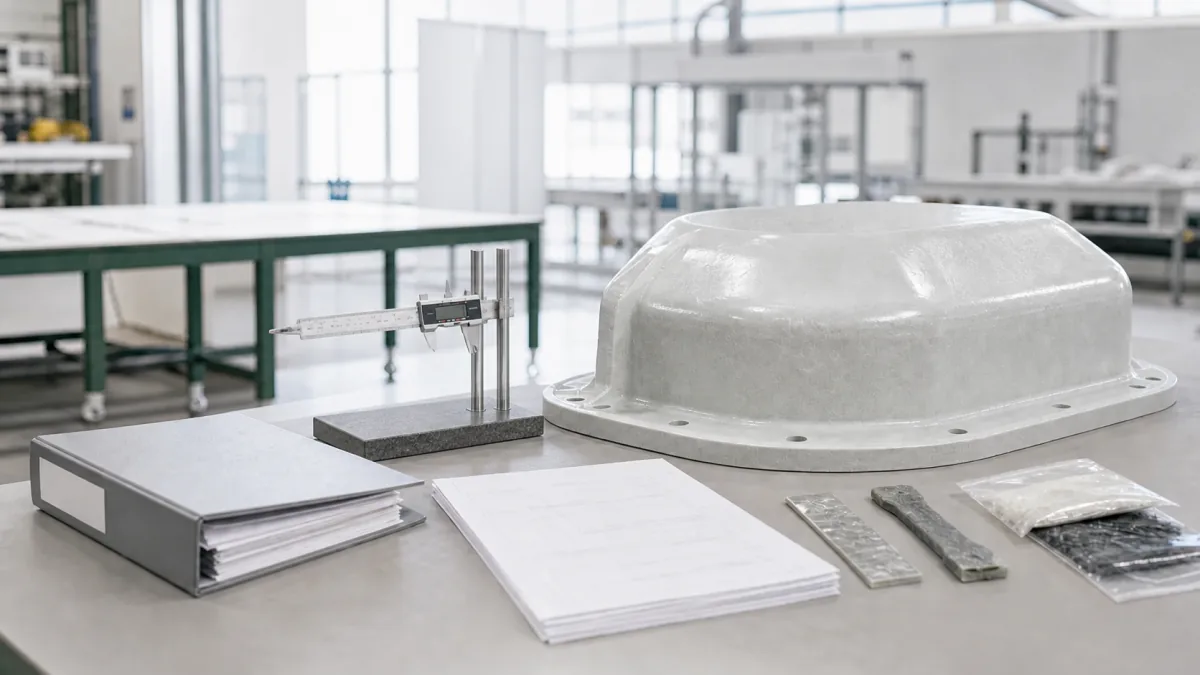
The right custom composite quality documentation is not the largest document package—it is the one that proves the requirements that matter for the part’s application. A cosmetic enclosure may need an approved finish sample and basic dimensional report. A safety-relevant structural component may require controlled material records, process traceability, detailed inspection results, and formal disposition of every deviation.
Start by defining how a defect would affect fit, function, appearance, safety, downstream assembly, or regulatory obligations. Then request documents that verify those risks without adding paperwork that does not improve acceptance confidence. The drawing, specification, purchase order, and quality plan should all point to the same acceptance criteria.
Match Documentation to Project Risk
Use the application’s consequences of failure to determine the documentation level. Requiring full traceability for every molded cover can increase administrative work without improving the product. Conversely, accepting a critical composite bracket with only a packing list may leave important questions unanswered.
A practical approach is to classify the part before issuing the RFQ:
| Project risk level | Typical examples | Useful documentation |
|---|---|---|
| Basic | Cosmetic panels, covers, noncritical housings | Approved drawing, finish reference, quantity verification, visual inspection confirmation |
| Moderate | Equipment guards, mounting panels, industrial enclosures | Controlled drawing, material identification, first-article dimensional report, visual inspection report, packing record |
| High | Load-bearing parts, critical interfaces, assemblies with strict traceability needs | Revision-controlled specifications, defined material and batch records, process traveler, detailed inspection report, nonconformance process, shipment-condition evidence |
This is a planning tool, not a substitute for an engineering risk assessment. A part may move into a higher documentation tier because of its environment, customer contract, integration into another assembly, or the cost of field replacement.
Before asking for any record, answer these questions:
- Which dimensions control fit or assembly?
- Which material properties are essential to the application?
- Are appearance, color, texture, or gloss part of acceptance?
- Is lot traceability needed for contractual, safety, or internal quality reasons?
- Does the part have a critical bonded insert, machined interface, or secondary operation?
- Who can approve a deviation, and what evidence must accompany it?
- How will parts be identified after receipt and during internal handling?
The output can be a simple document matrix attached to the purchase order. It should identify each document, its required format, when it is due, and the person or organization responsible for review.
Control Drawing Revisions and Acceptance Criteria
The drawing is usually the foundation of a custom composite quality package. If the drawing is unclear, inspection reports can be precise but still fail to answer whether the delivered part is acceptable.
Provide a revision-controlled drawing or model and state which source governs if there is a conflict. Include the revision identifier on the RFQ, purchase order, inspection report, and packing paperwork where practical. Avoid references such as “latest drawing” unless there is a controlled system for defining what “latest” means.
For composite parts, acceptance criteria often need more definition than a general dimensional drawing provides. Confirm:
- Overall dimensions, hole locations, trim lines, and interface surfaces
- Tolerances and the measurement reference points or datum scheme
- Whether dimensions apply to the molded part before or after trim, machining, or assembly
- Flatness, profile, angularity, and other geometric requirements when functionally necessary
- Thread, insert, bushing, fastener, or adhesive requirements
- Allowed flash, edge condition, fiber print-through, pinholes, voids, sink, and other visual conditions
- Color, texture, gloss, or grain references for visible surfaces
- Quantity, unit of measure, and acceptable overage or shortage rules
- Any required test method, sample size, or acceptance threshold
A common mistake is to call out a generic “smooth finish” or “no defects” requirement. Those phrases are subjective. Instead, use an approved physical sample, a marked-up image, a defined defect limit, or a written cosmetic standard. If surface appearance is important, specify the viewing distance, lighting condition, and visible side.
For dimensional acceptance, identify the dimensions that are genuinely critical. Applying an unnecessarily tight tolerance to every molded feature can create avoidable rejection risk and cost. Molded composites can be affected by tool design, material behavior, cure conditions, trimming, and part geometry. A manufacturability review before final release can help distinguish functional requirements from nominal preferences.
GFIND can review buyer drawings and application requirements as part of its custom FRP and carbon-fiber component project support. For an overview of custom composite options, see its custom composite solutions.
Define Material and Batch Records Where Needed
Material documentation should answer a specific question: what material system was used, and can the required material characteristics be traced when necessary?
For a basic noncritical part, a material description on the order or certificate of conformance may be enough. For a higher-risk item, request the records that connect the finished part to the approved material system. Depending on the part and agreement, this may include:
- Fiber type and form, such as fiberglass fabric, chopped strand reinforcement, or carbon-fiber fabric
- Resin system identification and any required flame, environmental, or performance characteristics
- Gel coat, pigment, coating, or finish material identification
- Core material, adhesive, insert, or hardware identification where applicable
- Supplier certificate of analysis or certificate of conformance, if required
- Material lot or batch numbers tied to the production lot
- Storage, shelf-life, or handling confirmation when the selected material requires it
Do not automatically request every supplier document available. A raw-material certificate may confirm information from the material supplier, but it does not prove that a finished part meets its drawing dimensions or visual requirements. Similarly, a material name alone does not establish performance in the final geometry.
Be specific about substitutions. If the buyer requires approval before changing resin, fiber architecture, core, insert, pigment, or finish system, state that requirement in the purchase order. “Equivalent material” is too open-ended unless equivalency criteria and approval authority are defined.
Also clarify the traceability unit. A “batch” could mean a raw-material lot, a single cure cycle, a shift, a production run, or a shipment. For most purchasing teams, the useful question is: if an issue is found, how narrowly can affected parts be identified?
Choose Process Records That Support Traceability
A process traveler is a route card, build record, or electronic log that follows a part or production lot through defined manufacturing steps. It is useful when the production history matters—not simply because a traveler exists.
For custom molded composite parts, a traveler may document:
- Work order or lot number
- Controlled drawing and process revision used
- Material lot references
- Tool or mold identification, if needed
- Key molding, curing, trimming, machining, assembly, or finishing steps
- Operator or inspection signoffs where agreed
- Rework, repair, or hold status
- Final release status
Request process records when the part has controlled materials, critical cure or bonding conditions, multiple secondary operations, or a contractual traceability requirement. A traveler can be especially valuable when a finished part includes inserts, adhesive bonds, machined interfaces, or a sequence of molding and finishing operations.
However, process data is only useful when it is connected to a defined requirement. Asking for a full cure log without stating what cure parameters are required can produce records that are difficult to evaluate. If the application needs a specific temperature range, time cycle, pressure condition, or bonding procedure, define the approved process and the reportable values in advance.
A sensible alternative for lower-risk work is a certificate of conformance stating that parts were manufactured and inspected to the agreed drawing and purchase order requirements. Confirm exactly what that certificate represents; it should not be treated as proof of undocumented tests.
Plan Dimensional and Visual Inspection Reports
Inspection reports should focus on characteristics that determine acceptance. The best report is readable, tied to the correct revision, and clear about what was measured, how many parts were checked, and whether results passed.
For a first article, prototype approval, or first production lot, request a ballooned drawing with matching report entries. The ballooned drawing assigns an identifier to each inspected feature, while the report lists the nominal value, tolerance, actual result, measuring method if needed, and pass/fail status.
A dimensional report can include:
- Part number, revision, lot number, and inspection date
- Sample quantity and sampling plan
- Critical dimensions and interface features
- Actual measurements, units, and tolerances
- Measurement equipment or method when relevant to interpretation
- Inspector review and disposition of out-of-tolerance findings
Visual inspection deserves its own criteria because a dimensional report cannot establish surface acceptability. For an FRP panel or carbon-fiber component, visual requirements may concern exposed weave consistency, resin-rich areas, porosity, color variation, trim quality, scratches, print-through, or coating defects.
Use an approved sample or visual standard for appearance-sensitive parts. A photograph can help, but lighting and image rendering can make it unreliable as the only acceptance reference. Keep a retained approved sample when color, texture, or gloss is important and define how it will be protected from damage or fading.
Be careful with 100% inspection language. It may be appropriate for a small number of critical features, but it should identify what is inspected on every part. A vague requirement for “100% inspected” is difficult to audit and may not address the features that matter most. For repeated production, define whether dimensional reporting is required for every shipment, each lot, periodic lots, or only when a process changes.
Handle Deviations and Nonconformances Clearly
A deviation is a proposed or identified departure from a requirement. A nonconformance is a condition that does not meet an agreed requirement. Buyers and suppliers should agree on a process for both before production begins.
The essential rule is simple: do not allow an out-of-specification part to be silently accepted, reworked, or shipped. Require written notice and disposition before shipment when a deviation affects a stated requirement.
A useful nonconformance report identifies:
- The affected part number, drawing revision, lot, and quantity
- The specific requirement that was not met
- The measured or observed condition
- Supporting photos, inspection results, or other evidence
- Proposed disposition, such as use-as-is, rework, remake, or return
- The buyer’s approval or rejection authority
- Any needed corrective action or containment for future production
Separate a deviation from a permanent engineering change. A one-time approval to use a part as-is should not automatically revise future acceptance criteria. If the design or process is to change permanently, update the drawing, specification, purchase order, and document package revision.
Buyers should also define whether repairs are permitted. Composite repair can be valid in some applications, but only when the repair method, location limits, inspection approach, and approval process are appropriate for the part’s function. A cosmetic patch acceptable on a hidden cover may be unacceptable on a visible panel or a critical load path.
Record Packing Identification and Shipment Condition
Damage after final inspection can create confusion at receiving. Packing documentation provides a basic record of what was released and how it was identified before shipment.
The needed level of evidence depends on fragility, value, surface sensitivity, and shipping method. For many custom composite orders, the package should include or be accompanied by:
- Part number and revision identification
- Lot number or date code if traceability is required
- Quantity per container and total shipment quantity
- Purchase order or release reference
- Handling labels, orientation markings, or stack limits when necessary
- Final inspection or release status
- Packing list
- Photographs of finished parts and packed condition when agreed
For appearance-sensitive molded surfaces, specify protective film, separators, sleeves, edge protection, or other packing requirements. For long, thin, or contoured parts, identify whether a support fixture or crate design is needed to prevent distortion or impact damage.
Photographs are supporting evidence, not proof that parts will arrive undamaged. Receiving teams should inspect packaging condition promptly, record visible damage, retain shipping materials when needed, and compare received labels with the packing list and required traceability documents.
Build a Practical Document Package for Repeat Orders
Repeat orders work best when the document package is stable, proportionate, and revision controlled. Requiring the same baseline records for each lot makes receiving predictable, while reserving more extensive reporting for first articles, design changes, new tooling, or identified quality risks.
A practical repeat-order package may look like this:
| Document | First article or new revision | Repeat lot | Trigger for update |
|---|---|---|---|
| Controlled drawing and specifications | Required | Reference current approved revision | Engineering change |
| Material identification | Required | Required if specified | Material or supplier change |
| Full material batch traceability | As risk requires | As risk requires | Traceability requirement or issue investigation |
| Dimensional report | Full critical-feature report | Per agreed frequency | Tool, process, or design change |
| Visual inspection record | Required | Required or summarized, as agreed | New finish standard or recurring defect |
| Process traveler | Required for controlled work | Required when traceability is needed | Process-route change |
| Nonconformance report | Only if an issue occurs | Only if an issue occurs | Any departure from requirements |
| Packing list and identification | Required | Required | Packaging or labeling change |
Create a one-page quality document matrix that names the document owner, format, due date, and approval status. For example, require an approved finish sample before production, a dimensional report before first shipment, and packing identification with every release. This avoids last-minute requests and gives procurement, engineering, and receiving teams the same expectations.
Common mistakes to avoid include requesting certificates with no stated purpose, failing to identify the drawing revision, treating a color name as a finish standard, using inconsistent lot definitions, and allowing verbal approvals for deviations. Each creates uncertainty that is much easier to prevent at the RFQ stage than after parts are molded.
For a custom composite RFQ, send the current drawing or model, intended application, critical characteristics, visual reference if applicable, desired traceability level, inspection expectations, and packing requirements. GFIND can use buyer drawings and application requirements to support manufacturability review, tooling, prototypes, molded production, finishing, inspection to agreed references, and shipment preparation. To discuss a document package aligned with your part’s needs, contact GFIND.