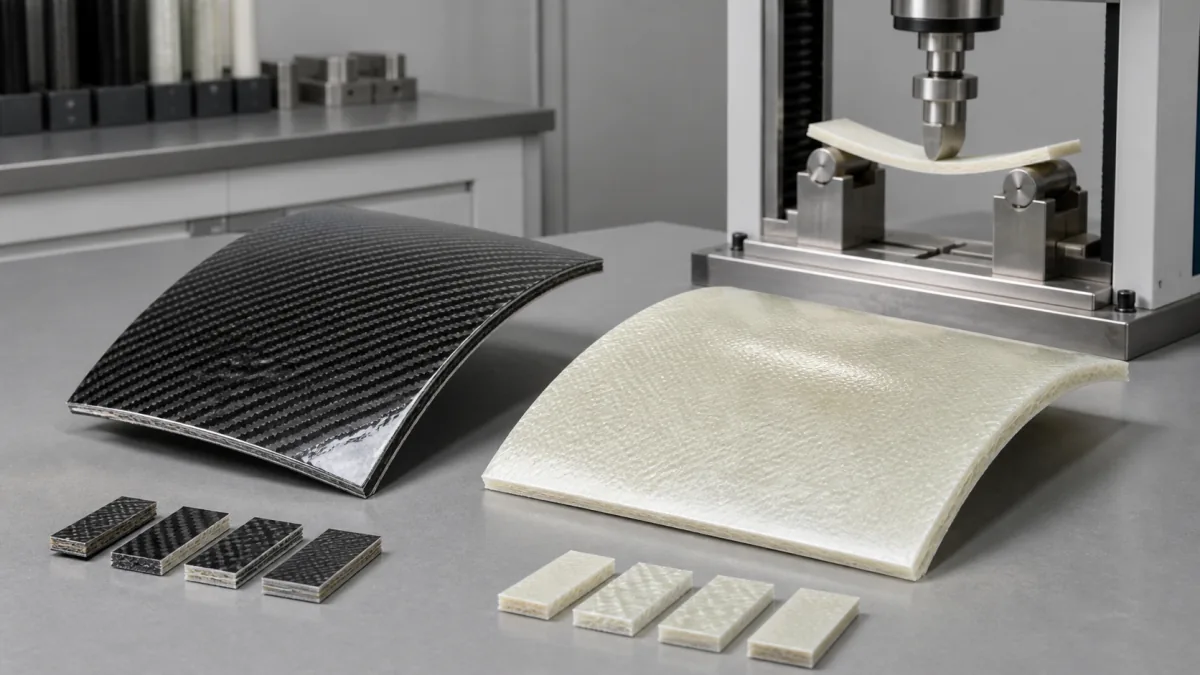
FRP Fire Performance Specification: A Practical Guide
Learn how to specify fire performance for custom FRP parts, including code authority, test methods, full construction, documents, and change control.
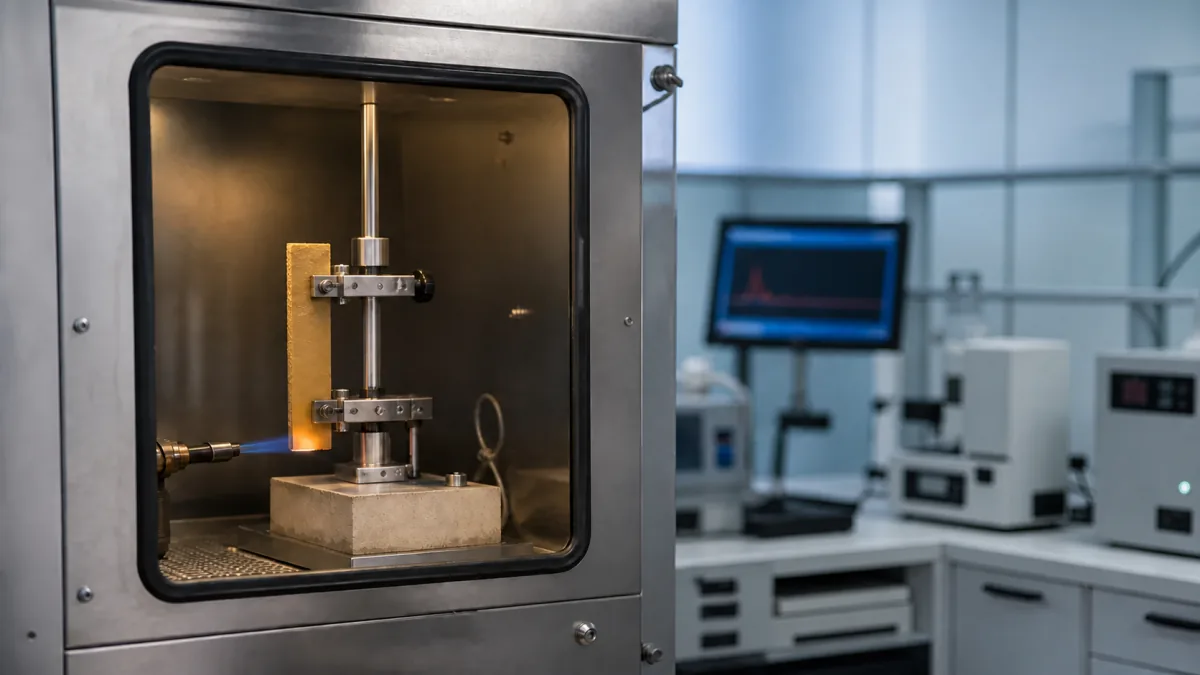
A sound FRP fire performance specification starts with the part’s actual use, the authority that will review it, and the exact test or code requirement. “Fire-rated FRP” is not a complete requirement: a resin system or laminate may perform differently when its thickness, pigment, core, adhesive, mounting method, or surface finish changes.
For a custom composite part, specify the required outcome rather than relying on a general material label. Identify the application, test standard, acceptance criterion, complete construction, documentation, and approval process for changes. This gives designers, suppliers, and inspectors a shared basis for evaluating the part.
Start With the Application and Governing Authority
The first question is not “Which fire-retardant resin should we use?” It is “What must this finished part satisfy in its installed application?”
In the United States, the governing requirement may come from a building code, local authority having jurisdiction (AHJ), project specification, transportation rule, insurer, customer standard, or product certification program. The applicable requirement can depend on whether the FRP component is:
- An interior wall or ceiling finish
- An exterior cladding or facade component
- A decorative architectural feature
- An equipment enclosure, electrical component, or machine guard
- A duct, tank, platform, door component, or industrial panel
- A vehicle, rail, marine, or aerospace component
- A part used inside a larger listed or certified assembly
The same molded FRP panel may face entirely different requirements when used as a wall finish versus an equipment cover. A low flame-spread result, for example, may be relevant to one material category but insufficient to establish compliance for a wall assembly, exterior facade, or occupied transportation application.
Before issuing an RFQ, document:
- End use and installation location: Interior, exterior, enclosed space, plenum, equipment room, vehicle cabin, and similar conditions.
- Applicable code edition and project specification: Include the edition, section, and any referenced standard where available.
- Reviewing party: Identify the AHJ, architect, engineer of record, owner, certification body, or customer department that will accept the evidence.
- Part function: Is the part purely decorative, a cover, a barrier, a structural element, or part of a fire-resistance assembly?
- Installation details: Substrate, fasteners, air cavity, seams, insulation, backing, penetrations, and adjacent materials may affect the applicable evaluation.
For architectural projects, early coordination is especially important. A material test report is not automatically evidence that a particular wall or facade design meets the project requirement. Buyers evaluating architectural facade panels should confirm whether the requirement applies to a coupon, a panel system, or the complete installed assembly.
Name the Required Test Method and Acceptance Level
A usable FRP fire performance specification names the test method, the acceptance threshold, and the version or authority basis for the requirement. Avoid language such as “must be fireproof,” “fire resistant,” or “Class A FRP” unless the project also defines exactly what those terms mean.
Common test methods may address different properties:
| Test or evaluation | What it generally addresses | Specification caution |
|---|---|---|
| ASTM E84 | Surface burning characteristics, commonly reported as flame spread index and smoke developed index | Results apply to the tested material and conditions; they do not establish fire resistance of an assembly. |
| UL 94 | Relative flammability behavior of small plastic specimens | A UL 94 classification is not interchangeable with a building-material classification. |
| ASTM D635 | Rate and extent of burning for plastics in a horizontal position | Useful only when specifically required; it is not a substitute for a code-required assembly test. |
| NFPA 286 | Fire testing of wall and ceiling interior finish assemblies or materials under defined conditions | The tested installation, dimensions, mounting, and associated materials matter. |
| ASTM E119 / UL 263 | Fire-resistance performance of building assemblies | This concerns a tested or evaluated assembly, not an individual FRP sheet or molding. |
| Cone calorimeter or project-specific heat-release testing | Heat release and related combustion behavior | Confirm test conditions, specimen orientation, reporting metrics, and pass/fail criteria. |
The correct test is determined by the application, not by the supplier’s preferred data sheet. For example, ASTM E84 may be requested for an exposed interior surface, while a system installed in a particular occupancy or configuration may require a different assembly-level evaluation. Similarly, UL 94 may be relevant for an electrical enclosure component but may not meet a building-code material requirement.
State acceptance values clearly. If a project requires an ASTM E84 classification, write the requested flame spread index and smoke developed index limits, along with the required specimen thickness and orientation. If the requirement is a named classification in a project manual, include the exact referenced language and ask the responsible code professional to clarify conflicts.
Also define whether the evidence must come from:
- A report for the exact construction
- A report for a permitted range of constructions
- A third-party certification or listing
- A project-specific test
- Review and acceptance by the AHJ or design professional
Define the Complete Tested Construction
FRP fire behavior is a construction-level issue, not merely a resin selection issue. A report for one laminate does not necessarily apply to another laminate that looks similar.
Describe the complete proposed construction in the specification and RFQ. At minimum, include:
- Reinforcement: Glass type, fabric or mat format, reinforcement loading, and orientation where relevant
- Resin system: Resin family, grade or approved formulation, cure system, and fire-retardant package
- Laminate schedule: Nominal thickness, number of plies, skin thickness, fiber content target, and core details
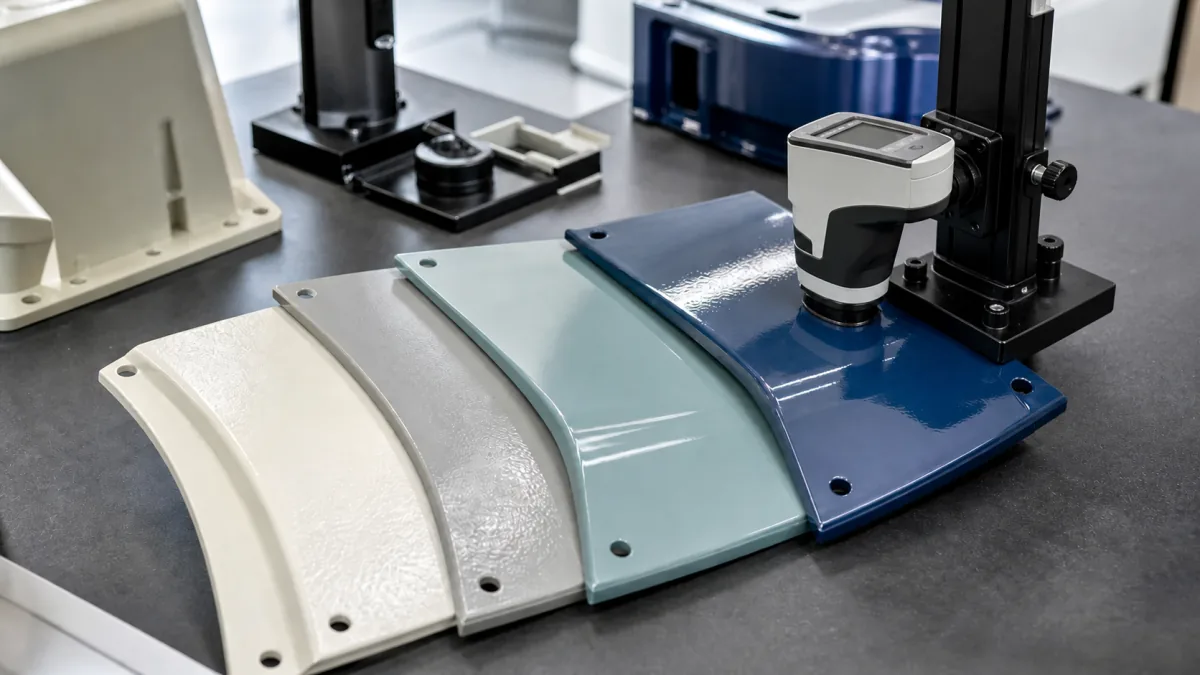
- Surface materials: Gel coat, paint, film, veil, texture, clear coat, ink, or decorative layer
- Color: Especially when pigment loading or dark colors may change the formulation
- Core and backing: Foam, honeycomb, wood, metal, insulation, liner, adhesive, or secondary substrate
- Geometry: Flat panel, corrugated profile, ribbed molding, hollow section, open-backed part, and section thickness variation
- Installation: Fasteners, clips, adhesive, framing, seams, edge treatment, cavity depth, and substrate
- Conditioning and orientation: Exposed face, specimen orientation, environmental conditioning, and installation direction if the test requires them
This level of detail may feel excessive for a small molded part, but it prevents a common mistake: treating a test result as transferable across a family of products without confirming the tested scope.
A gel-coated FRP panel mounted directly to a noncombustible substrate, for instance, may not represent the performance of the same panel over an air gap with combustible insulation and adhesive. A solid laminate may not represent a cored sandwich panel. Likewise, changing a molded surface to a painted finish can introduce materials that were not part of the tested construction.
When a test report identifies allowable ranges—such as a thickness range, color range, or set of approved substrates—include those boundaries in the procurement documents. Do not assume that “thicker is better” or “less resin is safer” for every fire test. The effect of a change depends on the method and construction.
Separate Flame, Smoke, Heat, and Structural Needs
Fire performance is not a single property. A specification should separate the required measures so that a supplier does not optimize for one result while overlooking another.
Flame propagation and ignitability
Flame-related requirements may concern flame spread, self-extinguishing behavior, burning rate, ignition response, or flame penetration. The relevant measure depends on the standard. A favorable result in one small-scale test does not predict all fire scenarios.
Smoke production and toxicity concerns
Smoke developed values may be specified for certain building applications. Some transportation, marine, or specialized projects may also call for smoke density, smoke toxicity, or gas analysis requirements. These are distinct from flame spread.
Do not infer low smoke or low toxicity from the phrase “flame-retardant resin.” If the project has a smoke-related requirement, name the required standard, measurement, threshold, and test conditions.
Heat release and fire growth
Heat release can be critical where a material contributes to fire growth. Requirements may involve peak heat release, total heat released, time-based limits, or an assembly-scale test. These requirements typically demand more precise construction control than a generic resin description.
Structural retention and fire resistance
A load-bearing FRP component can lose stiffness and strength as temperature rises, even if it contains flame-retardant additives. If a component must maintain separation, support load, protect an opening, or remain functional for a prescribed duration, the requirement may involve a fire-resistance-rated assembly or a specialized engineering evaluation.
Do not specify a flame-spread test when the real need is structural survival during a fire exposure. Conversely, do not call a decorative part “fire resistant” when the project only requires a surface-burning classification.
Control Resin Additives Pigments and Laminate Changes
Fire performance can shift when material formulations or part construction changes. Treat the selected resin system, additive package, pigment, laminate schedule, and finish as controlled design inputs.
The specification should identify what is fixed and what can vary. A practical approach is to divide changes into three groups:
| Change category | Examples | Recommended control |
|---|---|---|
| Typically controlled | Resin grade, fire-retardant additive package, pigment system, gel coat, core, adhesive | Require written review before substitution. |
| Potentially significant | Thickness, fiber architecture, filler content, cure parameters, paint system, backing material | Compare with the tested scope and obtain approval before production. |
| Installation-critical | Substrate, cavity, fasteners, seams, insulation, edge details | Confirm against the applicable assembly or project evaluation. |
Pigment is often overlooked. Colorants, fillers, and decorative layers can affect a formulation and may fall outside the scope of prior testing. The same is true of recycled content, alternative reinforcement formats, or cosmetic finishing processes. If color matching is important, specify that color development must remain within the approved fire-performance construction or be separately evaluated.
For custom parts, a manufacturability review can help identify where geometry or process choices create a conflict with the intended fire-performance basis. GFIND can review buyer drawings and application requirements when developing custom FRP or carbon-fiber components, but the buyer should provide the governing fire criteria and required evidence at the outset.
Ask for Relevant Reports Without Overgeneralizing
Request documentation that is relevant to the actual part and application. A supplier data sheet may be useful background, but it is not automatically enough for a permit reviewer, engineer, or customer quality team.
Ask for the following as applicable:
- The full test report or a report summary that identifies the laboratory, method, test date, specimen description, and results
- The exact material construction tested, including resin, reinforcement, thickness, finish, color, core, backing, and mounting condition
- Any report limitations, permitted ranges, conditions of use, or exclusions
- Product data sheets for the proposed resin, gel coat, core, adhesive, and finish
- A bill of materials or controlled laminate schedule tied to the proposed part number
- A certificate of conformance only when it states what it certifies and against which agreed reference
- Third-party listing or certification details when the project explicitly requires them
- A change-notification process for controlled materials or construction details
Read reports carefully. A report may describe a specimen as “FRP panel” while the details reveal a specific thickness, gel coat, substrate, and mounting arrangement. Those details define the relevance of the result.
Be cautious of broad claims such as “ASTM E84 compliant,” “UL 94 rated,” or “fire-rated composite” without an accompanying construction description. The right follow-up question is: Does this report cover the exact proposed part and installation, or what differences must be evaluated?
For a new design, it is often useful to put the documentation requirements directly into the RFQ. This reduces the risk of selecting a material based on an early assumption that later proves insufficient for project approval.
Plan Project Testing and Change Control
When no existing report covers the required construction, plan verification before committing to production tooling, final finishes, or installation details. Early planning can avoid expensive redesign after samples have been approved for appearance but not for fire performance.
A practical verification plan usually includes these stages:
- Requirements review: Confirm the governing authority, code path, test method, acceptance values, and document format.
- Construction freeze for test samples: Lock the resin, additive system, reinforcement, thickness, surface finish, color, core, adhesives, and mounting configuration.
- Test specimen planning: Confirm sample size, quantity, conditioning, orientation, substrate, and installation with the selected laboratory or responsible reviewer.
- Test and review: Evaluate the report against the specified acceptance criteria and any conditions of use.
- Production release: Tie the approved construction to drawings, bills of materials, process controls, inspection references, and part identification.
- Change control: Require review before material substitutions, thickness changes, finish revisions, or installation changes that could exceed the tested scope.
Prototype parts can be valuable for fit, appearance, and process development, but they should not be represented as compliance samples unless they use the final controlled construction and meet the laboratory’s specimen requirements.
Testing also has limits. Passing a test does not automatically create a broad product approval, satisfy every jurisdiction, or cover future design variations. Confirm what the report actually supports before using its result in submittals, marketing, or installation documentation.
Keep Compliance Responsibility Explicit
A clear specification assigns responsibilities instead of assuming the FRP manufacturer, installer, architect, laboratory, and AHJ are making the same determination.
The buyer or project team should typically define the intended use, governing requirement, acceptance criteria, and required approval route. The manufacturer should identify the proposed construction, disclose whether supplied documentation applies to that construction, and control agreed materials and production references. The installer should follow the approved installation details. The AHJ, design professional, certification body, or customer remains responsible for its own review and acceptance decisions.
Use careful contract and submittal language. For example:
The supplier shall provide the proposed FRP construction and available fire-performance documentation for review. No material substitution, laminate revision, surface-finish change, core change, or installation change may be made without written review against the project’s stated fire-performance requirements.
This is more useful than requiring “fire-rated FRP” because it identifies the decision points that can affect compliance.
For custom applications, include the final drawing revision, material schedule, required test method, pass/fail level, installation assumptions, documentation deliverables, and change-control requirements in the purchase documents. That creates a traceable basis for sourcing rather than relying on a broad product claim.
If you are preparing a custom composite RFQ, review the available custom composite solutions and organize the fire-performance inputs before submitting your part drawings. For help discussing manufacturability, documentation needs, and the proposed construction, you can contact GFIND with the application details and governing requirement.