FRP Resin Selection for Chemical Exposure: A Practical Guide
Choose an FRP resin system with a complete exposure profile: chemicals, concentration, temperature, duration, cleaning, loads, joints, and validation.
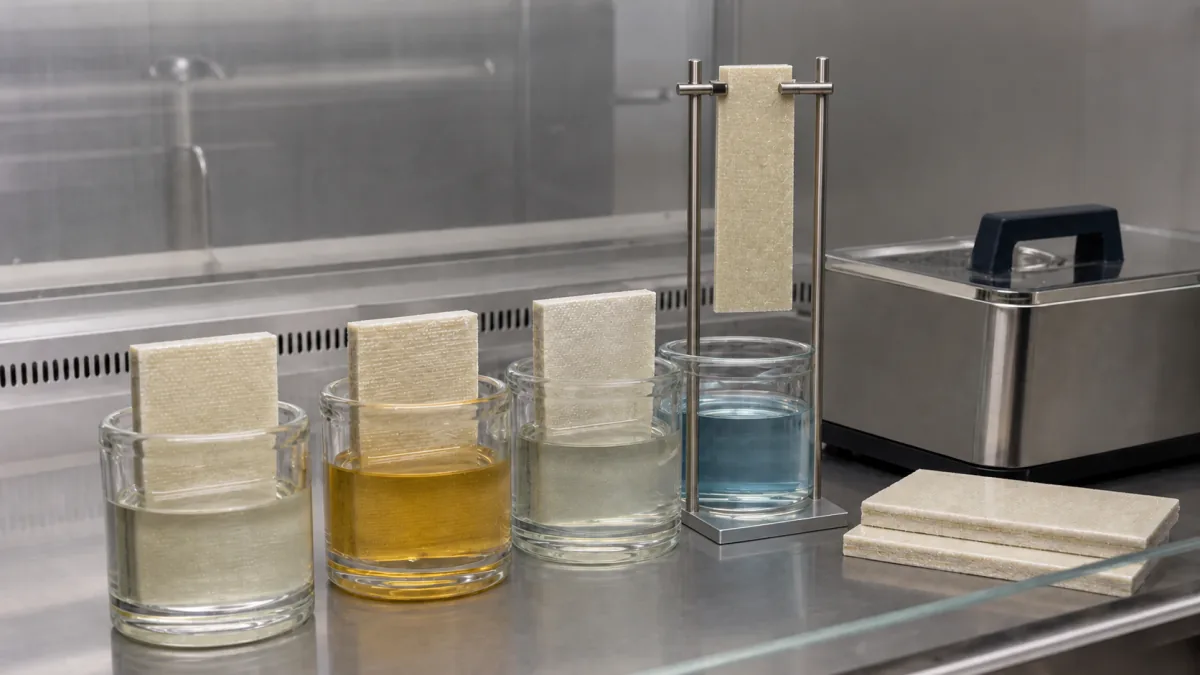
FRP resin selection for chemical exposure starts with the service environment, not a generic resin label. A resin that performs well with one dilute chemical at room temperature may be unsuitable for a hotter, more concentrated solution, a mixed waste stream, repeated washdown, or continuous immersion.
Before specifying fiberglass-reinforced plastic (FRP), create an exposure profile that identifies every chemical, its concentration, temperature, contact pattern, cleaning process, mechanical loads, and possible leak paths. Then use supplier compatibility information and project-specific testing or qualification to confirm that the proposed laminate is appropriate for the actual application.
List Every Chemical and Cleaning Agent
Start with a complete chemical inventory. “Acid service,” “corrosion resistant,” or “outdoor chemical exposure” is not enough information to select an FRP resin system responsibly. Resin compatibility depends on the specific chemical and the full operating condition.
Include process chemicals as well as anything used during cleaning, maintenance, sanitizing, or spill response. A component can be compatible with its main process fluid but degrade prematurely when exposed to a concentrated cleaning product or incompatible solvent.
Your inventory should identify:
- Chemical name and, when applicable, chemical family
- CAS number or safety data sheet (SDS)
- Whether the material is acidic, alkaline, oxidizing, solvent-based, or a mixed stream
- Process additives, catalysts, salts, surfactants, dyes, oils, and contaminants
- Cleaning and disinfection agents
- Maintenance chemicals, including degreasers and adhesive removers
- Expected spill chemicals and emergency washdown agents
- Whether the chemical is liquid, vapor, mist, condensate, slurry, or powder
Mixtures deserve special attention. A compatibility chart may show acceptable performance for each ingredient individually, but a blend can behave differently. Mixed waste streams can also vary over time, particularly in industrial treatment, manufacturing, and processing applications.
For an RFQ, provide SDS documents where available. If the chemistry is confidential, describe the relevant exposure characteristics under an appropriate confidentiality process: pH range, solvent class, oxidizing potential, concentration range, temperature, and contaminant types.
Record Concentration, Temperature, and Contact Time
Chemical resistance is conditional. The same resin can face very different risks depending on concentration, heat, and duration of exposure. These three inputs should be recorded as operating ranges—not just nominal values.
Concentration
A low-concentration chemical solution may be manageable while a stronger solution is not. Do not report only the normal concentration if process upsets, batch changes, evaporation, or incomplete dilution can increase it.
Specify:
- Normal operating concentration
- Maximum foreseeable concentration
- Concentration during startup, shutdown, and cleaning
- Whether the solution can concentrate through evaporation
- Whether solids settle, separate, or form deposits against the FRP surface
Temperature
Elevated temperature often accelerates chemical attack, diffusion, softening, and loss of properties. The maximum sustained temperature is usually more important than a brief ambient reading.
Document:
- Normal operating temperature
- Maximum continuous temperature
- Peak excursion temperature and duration
- Temperature during cleaning cycles
- Thermal cycling frequency
- Whether one side of the laminate is hotter than the other
Do not assume that a resin’s published heat-distortion or general temperature rating proves chemical suitability at that temperature. Chemical exposure and heat act together, and the acceptable limit may be lower than either condition considered separately.
Contact time
Distinguish occasional splashes from repeated wetting and continuous immersion. A cabinet wall exposed to brief drips has different needs than a tank liner, duct interior, scrubber component, or process cover that remains wet for months.
A useful exposure record states both frequency and duration:
| Exposure condition | Information to provide | Selection concern |
|---|---|---|
| Continuous immersion | Fluid level, temperature, concentration, expected service duration | Permeation, hydrolysis, resin softening, barrier durability |
| Intermittent wetting | Cycle length, dry time, number of cycles | Wet/dry cycling and deposit buildup |
| Splash or spill | Volume, frequency, cleanup method, dwell time before removal | Localized attack at seams, edges, and hardware |
| Vapor or condensate | Chemical vapor, condensation rate, surface temperature | Condensate chemistry may differ from bulk fluid |
| Washdown | Cleaner, concentration, temperature, pressure, frequency | Combined chemical, thermal, and mechanical exposure |
Separate Immersion, Splash, Vapor, and Outdoor Exposure
Exposure mode changes the risk. A material selected for a splash zone should not automatically be used for immersion, and an outdoor enclosure may need to manage both weathering and internal chemical vapors.
Immersion
Immersion is typically the most demanding condition because the laminate remains in contact with the chemical. The resin-rich surface, corrosion barrier, laminate construction, cure quality, and any service-side finish all matter. Permeation can become important even when there is no visible surface damage.
Splash and spill exposure
Splash exposure can be less severe than immersion, but it is often unpredictable. Spills can collect around flanges, corners, support feet, fasteners, and horizontal ledges. Determine whether spill cleanup happens promptly or whether residue can remain in place.
Vapor, mist, and condensation
Chemical vapor is not necessarily mild exposure. Hot vapor can condense on cooler FRP surfaces, creating a concentrated liquid film. Mists and aerosols can settle in seams or behind covers. Identify the vapor chemistry, humidity, surface temperatures, and ventilation conditions.
Outdoor exposure
Outdoor FRP components may encounter ultraviolet light, rain, freeze-thaw cycling, moisture, airborne contaminants, and internal chemical exposure at the same time. The resin system and surface protection should be considered alongside the intended service environment. For broader guidance on moisture and weathering mechanisms, see how fiberglass products resist corrosion, moisture, and weathering.
Review Resin, Reinforcement, and Barrier-Layer Options
The resin is central to chemical resistance, but it is not the only material decision. FRP performance depends on the complete laminate: resin chemistry, reinforcement type, resin content, corrosion barrier, curing system, fabrication method, thickness, and details at connections.
Common resin families considered for chemical-service FRP include:
| Resin family | General role in chemical-service FRP | Important qualification point |
|---|---|---|
| Orthophthalic polyester | Often used in less demanding general-purpose applications | Do not assume broad resistance to strong chemicals or immersion |
| Isophthalic polyester | Can offer improved performance over general-purpose polyester in some environments | Compatibility still depends on exact chemical and temperature |
| Vinyl ester | Often considered where higher chemical resistance is needed | Formulation and laminate design must be checked for the service |
| Epoxy | Can provide useful resistance in certain applications | Not universally suitable, especially across all acids, oxidizers, or solvents |
| Specialty resin systems | May be considered for unusually aggressive duty | Confirm fabrication, cure, barrier construction, and service-specific data |
These categories are screening tools, not final specifications. “Vinyl ester” alone is not a complete material callout because formulations differ. The resin must be evaluated against the actual chemical profile and process conditions.
Reinforcement matters
Glass reinforcement is common in FRP, but fiber type and construction affect performance. Some chemical environments can attack glass fibers if the resin-rich barrier is compromised or the laminate is poorly protected. Reinforcement selection may also affect stiffness, strength, surface finish, thermal behavior, and fabrication options.
Carbon fiber components require separate evaluation because carbon fiber is electrically conductive and can create galvanic concerns when paired with certain metals in wet service. It should not be treated as a drop-in substitute for fiberglass in a chemical environment.
Corrosion barriers and liners
For aggressive service, the service face may need a corrosion barrier or liner rather than relying on a structural laminate alone. Depending on the design, this can include a resin-rich inner layer, surfacing veil, multiple barrier plies, or another specified protective construction.
A barrier is not a cure for every problem. It must be continuous, properly cured, and protected at cutouts, seams, and repairs. Specify which surface faces the chemical and whether both sides may be exposed.
Account for Joints, Cut Edges, and Penetrations
Many FRP chemical-service failures begin at details rather than broad flat surfaces. A sound laminate can be undermined by an unsealed cut edge, an incompatible gasket, a poorly designed joint, or liquid trapped around a fastener.
Review every location where the chemical barrier is interrupted:
- Bonded joints and secondary bonds
- Mechanical fasteners
- Bolt holes and inserts
- Pipe, conduit, and cable penetrations
- Cut edges and drilled holes
- Doors, hatches, access panels, and hinges
- Flanges, seals, and gaskets
- Transitions between FRP and metal components
- Drainage points, corners, and horizontal ledges
State whether joints will be factory-made, assembled in the field, or periodically opened for maintenance. Field cutting or drilling can expose unprotected reinforcement if procedures do not include edge sealing or chemical-resistant finishing.
Also check adjacent materials. A compatible FRP panel does not make an assembly compatible if its adhesive, sealant, gasket, coating, metal insert, or fastener fails first. In wet chemical service, metal-to-composite interfaces may require attention to crevices, galvanic effects, and differential thermal movement.
Define Structural and Fire Requirements Separately
Chemical resistance does not establish structural adequacy, and structural strength does not establish chemical compatibility. Treat these as related but separate requirements.
For structural design, define the actual loads and constraints:
- Dead load and mounted equipment weight
- Internal or external pressure
- Wind, snow, seismic, vibration, and impact loads where applicable
- Span, support spacing, deflection limits, and attachment points
- Repeated loading, fatigue, and handling loads
- Operating temperature and thermal expansion
- Required stiffness, not only ultimate strength
For a custom enclosure, cover, guard, or equipment housing, the chemical side may be only one part of the design. The part may also need access doors, lifting features, mounting interfaces, electrical isolation, or a controlled finish. Buyers planning this type of project can review custom industrial equipment enclosure options alongside their material requirements.
Fire performance must also be specified separately. Terms such as “fire retardant,” “self-extinguishing,” and “flame spread” are not interchangeable. If a project requires a particular fire test, smoke requirement, building-code criterion, or end-use approval, state the exact standard, test method, acceptance threshold, and whether the requirement applies to the finished part or the resin alone.
Avoid assuming that adding a fire-retardant formulation leaves chemical resistance, mechanical properties, appearance, and processing unchanged. Those tradeoffs require review.
Use Supplier Data and Project-Specific Validation
Published chemical-resistance data is useful for preliminary screening, but it has limits. Charts often reflect specific test conditions, resin formulations, cure schedules, laminate constructions, and exposure periods. They may not represent your exact chemical mixture, temperature cycle, or loaded component geometry.
Use supplier data to narrow the choices, then determine what level of validation is appropriate for the risk of the application.
A practical validation path may include:
- Review the complete exposure profile. Confirm chemical names, concentrations, temperatures, and contact modes.
- Screen candidate resin systems. Use current technical data from the resin supplier or qualified material source.
- Confirm the proposed laminate. Review reinforcement, barrier construction, thickness, cure, finish, and fabrication method.
- Evaluate vulnerable details. Include bonded joints, penetrations, fasteners, gaskets, and cut edges.
- Select appropriate validation. This may involve coupon exposure, prototype evaluation, dimensional checks, visual inspection, or property testing after exposure.
- Set acceptance criteria before testing. Define what constitutes acceptable mass change, appearance, hardness, strength retention, leakage resistance, or dimensional stability for the project.
The required evidence should match the consequence of failure. A removable splash shield may need a different level of confirmation than a continuously immersed, load-bearing process component. If a code, owner specification, insurer, or engineering authority requires a particular qualification method, include that requirement at the beginning rather than after fabrication begins.
Document the Final Material Specification
The final specification should communicate more than “chemical-resistant FRP.” It should give manufacturers and reviewers a clear basis for building and inspecting the part.
Include the following in the RFQ, drawing package, or engineering specification:
- Component description, drawing revision, dimensions, and tolerances
- Chemical inventory with SDS documents or equivalent exposure details
- Normal and maximum chemical concentrations
- Normal, maximum continuous, and excursion temperatures
- Exposure mode: immersion, splash, vapor, condensate, washdown, or outdoor exposure
- Exposure frequency, duration, and expected service pattern
- Required resin family or approved resin options, if already determined
- Reinforcement and corrosion-barrier requirements, where applicable
- Which surfaces require chemical protection
- Joint, edge-sealing, penetration, gasket, and hardware requirements
- Structural loads, supports, deflection limits, and attachment details
- Fire, electrical, surface-finish, color, and UV requirements
- Inspection points, documentation needs, and acceptance criteria
- Required prototype, coupon, or qualification testing
- Packing, handling, and shipment requirements for the finished component
It is also helpful to identify what remains open for supplier review. For example, the buyer may prescribe chemical exposure and geometry while asking the fabricator to recommend a manufacturable laminate construction. GFIND can review buyer drawings and application requirements for manufacturability, tooling, prototypes, molded production, finishing, and inspection to agreed references.
Common FRP Chemical-Resistance Mistakes
Several shortcuts can lead to an incomplete selection:
- Selecting resin by chemical name without confirming concentration and temperature
- Treating intermittent washdown as insignificant
- Assuming a general corrosion-resistant resin suits all acids, bases, oxidizers, and solvents
- Ignoring vapor condensation because there is no bulk liquid contact
- Specifying the panel laminate but not edges, holes, joints, or seals
- Using a material chart as a final design approval
- Combining fire and chemical requirements without checking formulation tradeoffs
- Omitting maximum upset conditions from the RFQ
- Failing to define validation criteria before sample or prototype work begins
FAQ
Is vinyl ester always the best FRP resin for chemical exposure?
No. Vinyl ester resins are frequently evaluated for demanding chemical environments, but suitability depends on the exact formulation, chemical mixture, concentration, temperature, exposure duration, laminate construction, and design details. It should be selected through compatibility review, not by resin family name alone.
Can an FRP part be repaired after chemical damage?
Sometimes, but repair feasibility depends on the extent of chemical attack, whether reinforcement has been affected, the location of the damage, and whether the original corrosion barrier can be restored. A repair plan should address root cause, surface preparation, compatible repair materials, cure requirements, and inspection.
What is the most useful information to send with an FRP RFQ?
Send the drawing, chemical inventory, SDS documents when available, concentration and temperature ranges, exposure mode, cleaning schedule, structural loads, fire requirements, and any required validation or inspection criteria. This gives the supplier a practical basis for reviewing the material system rather than making assumptions.
A well-defined exposure profile makes FRP resin selection more reliable and makes supplier comparisons more meaningful. If you are developing a custom composite part, you can contact GFIND with the drawing and service conditions for a manufacturability and material-review discussion.