FRP Water Slide RFQ Requirements: A Practical Guide
Plan a complete FRP water slide RFQ with route geometry, joints, supports, hydraulic inputs, finish, shipping sections, and approval responsibilities.
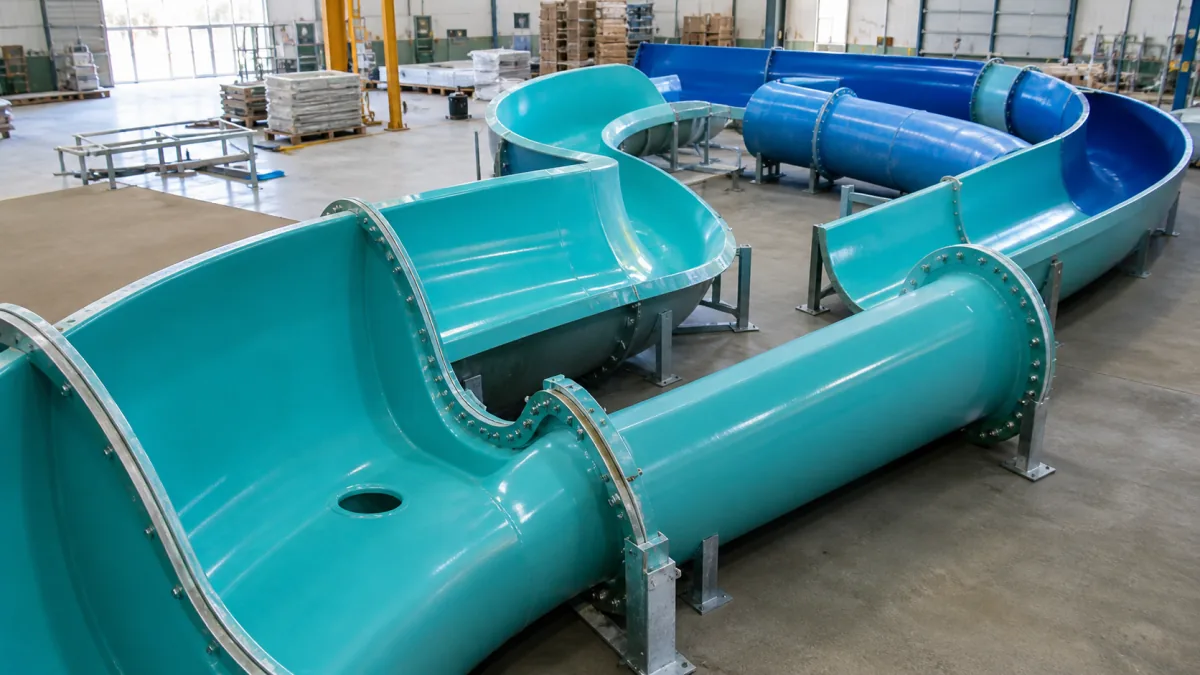
A complete FRP water slide RFQ should define more than the visible flume path. It needs released route geometry, section boundaries, joint details, support interfaces, water and drainage conditions, rider-related engineering inputs, finish expectations, transport limits, and a clear allocation of design and approval responsibility.
The more complete the package, the easier it is for a composite manufacturer to assess manufacturability, identify open interfaces, and quote the appropriate tooling, molded sections, finishing, inspection, and shipment preparation. An RFQ should not assume that the slide manufacturer, structural engineer, aquatic designer, installer, and owner are all responsible for the same decisions.
Define the Complete Water Slide System
Start by defining what is included in the requested FRP scope and what remains with other project parties. A water slide is a coordinated system, not simply a collection of fiberglass shells.
At minimum, identify whether the RFQ includes:
- Entry section, launch platform interface, and start tub
- Open flume, enclosed tube, or mixed slide sections
- Curves, drops, transitions, bowls, funnels, loops, and runout sections
- Exit geometry and splashdown or catch-pool interface
- Decorative elements, themed cladding, or external covers
- Mounting flanges, backing plates, embedded inserts, and hardware interfaces
- Support steel interfaces and connection points
- Water delivery components, drains, overflow provisions, and penetrations
- Access panels, inspection openings, or maintenance doors
- Field assembly requirements, including sealant and fastener expectations
- Finish, color, graphics, and UV exposure requirements
A useful RFQ separates the FRP component scope from the site system scope. For example, slide flume sections may be supplied as molded FRP components, while support steel, foundations, pumps, piping, electrical work, installation labor, and field inspections are separately procured. State these boundaries directly instead of leaving them to inference.
Also identify the project phase. A concept-stage request may need preliminary manufacturability input and budgetary assumptions. A production RFQ should use released drawings, defined interfaces, and an identified party responsible for approving final geometry.
For examples of component types that may affect an RFQ package, review fiberglass pool and water slide solutions. Complex forms, including enclosed or looping configurations, usually require more detailed geometry and interface control than a straight open flume.
Provide Released Route and Section Geometry
Route geometry is the foundation of an FRP water slide RFQ. A manufacturer needs enough information to understand the molded shape, determine practical mold breaks, and evaluate how sections can be fabricated and assembled.
Provide the following whenever available:
- 3D CAD models in an agreed neutral or native format
- 2D drawings with dimensions, elevations, stationing, and datum references
- Centerline route data, including horizontal and vertical curves
- Cross-sectional profiles at regular stations and all transitions
- Flume inside width, wall height, floor shape, and tube diameter where applicable
- Entry, exit, and transition geometry
- Slide slope, banking, pitch, roll, and twist requirements
- Overall elevations relative to project benchmarks
- Coordinate system, units, drawing revision, and tolerances
- A section schedule showing each proposed manufactured piece
Do not rely solely on a rendering, animated ride model, or overall layout drawing. These materials may communicate appearance but usually do not establish the controlled surfaces required to make tooling and molded parts.
Clarify who owns rider and hydraulic design
The slide path affects rider behavior, water distribution, drainage, and loads. The RFQ should state which qualified party is responsible for ride geometry, rider dynamics, water flow design, and final system performance.
A composite fabricator can manufacture to approved geometry and may identify practical molding concerns, but that is different from assuming responsibility for ride engineering. If the project is using a specialist aquatic designer or licensed engineer, include their issued geometry and identify the revision that governs.
Important questions include:
- Is the supplied route geometry final and approved for intended rider use?
- Who establishes rider height, age, weight, and dispatch assumptions?
- Who evaluates speed, g-forces, containment, and exit conditions?
- Who defines required water flow and its distribution along the ride path?
- Who reviews interactions between the slide exit and pool, runout, or deceleration system?
- Who approves changes needed for molding, transport, or installation?
When route geometry is still evolving, label it as preliminary. Request separate pricing or assumptions for design development, prototypes, tooling changes, or revision-controlled production release rather than treating a concept model as final manufacturing data.
Coordinate Supports, Flanges, and Joint Access
The flume, structural supports, joints, and installation hardware must work together. An RFQ that only provides the visible slide surface can leave critical interface questions unresolved until the site work is underway.
For each section, show or specify:
- Support locations and support reactions, where established by the responsible engineer
- Saddle, bracket, hanger, or steel-frame interface geometry
- Mounting pad dimensions and reinforcement zones
- Bolt patterns, hole sizes, hardware grades, and access direction
- Flange type, flange width, mating-face requirements, and gasket or sealant interface
- Overlap direction at joints, especially where water flow crosses a seam
- Field-fit allowance and dimensional adjustment method
- Required clearance around bolts, nuts, tools, and sealing operations
- Restrictions on drilling, trimming, or modifying FRP in the field
- Loads or attachments imposed by external elements such as lighting, theming, or piping
Design joints for installation, not only for CAD assembly
A joint that looks acceptable in a model may be difficult to seal or fasten after adjacent sections are installed. Confirm whether installers can physically reach both sides of the flange, position sealant, tighten fasteners, and inspect the completed joint.
Common joint-access issues include:
- Bolts located too close to support steel or wall surfaces
- Enclosed tube joints with no workable internal access
- Flanges hidden behind decorative skins or inaccessible after erection
- Required tool clearances not considered in the support layout
- Joint seams placed where water can pool if drainage is inadequate
- Section weights or shapes that make alignment difficult during lifting
Include an installation sequence or erection concept when it is available. This helps determine whether a section must be lifted before neighboring steel is installed, whether temporary supports are needed, and where lifting provisions may be required.
Confirm who supplies fasteners, sealants, gaskets, covers, and field touch-up materials. These items affect joint performance but are often omitted from early RFQs.
Share Water Flow, Drainage, and Operating Inputs
Water flow is a system input, not a detail to add after the FRP geometry is released. It influences the slide floor, penetrations, water manifolds, entry conditions, drainage features, and requirements for smooth transitions.
Provide the operating information relevant to the requested scope:
| Input | What to define in the RFQ | Why it matters |
|---|---|---|
| Water delivery | Target flow rates, delivery points, nozzle locations, and supply interfaces | Helps coordinate penetrations and water-distribution features |
| Water chemistry | Expected treatment approach and exposure conditions | Supports material, finish, sealant, and hardware selection discussions |
| Drainage | Low points, drain locations, drain connection details, and winterization needs | Reduces standing-water and maintenance concerns |
| Operating environment | Indoor or outdoor use, sun exposure, temperature range, and splash exposure | Affects finish and weathering considerations |
| Cleaning | Intended cleaning methods and chemicals | Helps avoid incompatible surface-care assumptions |
| Operating schedule | Seasonal, continuous, or intermittent operation | Can affect drainage, access, and maintenance planning |
State whether water penetrations are molded, drilled after molding, or installed by another trade. If penetrations must align with piping, provide the pipe routing, connection size, location tolerance, and service access requirements.
Drainage deserves specific attention. Identify low points in the route, how water leaves enclosed sections during shutdown, and whether the site requires winterization provisions. Water trapped in inaccessible areas can complicate maintenance and field operations.
Do not assume a molded slide component includes pumps, valves, filtration, or hydraulic controls unless they are explicitly in scope. Likewise, a flume supplier should not be expected to infer water flow requirements from slide length alone.
Set Surface Finish and Inspection Requirements
The riding surface is a functional surface. It should be specified by defined acceptance criteria rather than broad descriptions such as “smooth” or “high quality.”
An RFQ should identify:
- Interior and exterior finish requirements
- Color, color-reference system, and acceptable variation
- Gloss expectations, if relevant
- Rider-contact surface requirements
- Permitted seams, witness lines, fastener recesses, and repair areas
- Areas that may receive graphics, wraps, theming, or protective coatings
- UV and weather-exposure expectations for outdoor installations
- Criteria for visible defects, cosmetic repairs, and surface discontinuities
- Inspection method, inspection locations, and acceptance references
- Required documentation, photos, dimensional checks, or first-article approvals
Define the reference standard for acceptance
“Smooth” can mean different things to a designer, installer, operator, and manufacturer. A clearer approach is to identify representative areas, approved samples, surface classifications, or project drawings that establish what is acceptable.
For example, distinguish between:
- Rider-contact interior surfaces: prioritize continuity, safe transitions, and the specified finish.
- Exterior visible surfaces: define cosmetic appearance, color consistency, and allowable repair visibility.
- Hidden structural areas: focus on dimensional fit, laminate integrity, and interface functionality as defined by the project.
If the project requires inspection by an owner representative, third party, or engineer, identify when it occurs: before shipment, after delivery, after field assembly, or at more than one stage. Also state how nonconforming conditions will be documented and dispositioned.
Avoid specifying a finish by brand name alone without functional criteria. If a named coating, pigment, or gel coat system is required, include the full applicable specification and determine who must approve substitutions.
Divide Sections Around Transport and Installation
FRP water slide sections must be sized for real-world transport, unloading, lifting, site access, and field assembly. The largest possible molded section is not always the most practical or economical section.
Section breaks should consider:
- Maximum shipment dimensions and load restrictions
- Permitted route constraints, bridge clearances, and delivery access
- Jobsite gate widths, turning radii, and staging area
- Crane or lifting equipment capacity and reach
- Available rigging points and the ability to control irregular shapes
- Installation sequence and access to bolts and seals
- Location of support interfaces
- Changes in curvature, transitions, and high-visibility locations
- Number of field joints versus transportation complexity
Compare fewer joints with easier logistics
There is a tradeoff between reducing field joints and keeping sections manageable.
| Approach | Potential benefit | Potential limitation |
|---|---|---|
| Larger molded sections | Fewer joints and less field sealing | More difficult transport, handling, lifting, and site access |
| Smaller molded sections | More manageable shipping and installation | More joints, hardware, sealing, alignment, and inspection work |
| Breaks at natural transitions | Can make seams less visually prominent | May not align with support or transport needs |
| Breaks at support zones | May simplify structural interfaces | Must still preserve joint access and water-shedding behavior |
Ask the manufacturer to identify proposed section boundaries and commercial assumptions. Then have the installer and project engineer review them before tooling is authorized.
Include shipment requirements in the RFQ: preferred delivery format, packaging constraints, labeling, unloading responsibility, storage limitations, and whether sections must arrive in a specific erection sequence. A section that arrives undamaged but cannot be staged or lifted safely is still a project problem.
Identify Codes, Qualified Engineers, and Approvals
A water slide project may involve building, structural, electrical, plumbing, public-health, amusement-device, accessibility, and local permitting requirements. The applicable requirements vary by jurisdiction, facility type, and slide configuration.
The RFQ should identify:
- Project location and authority having jurisdiction, if known
- Applicable codes, standards, owner standards, and contract specifications
- Which party is responsible for code interpretation
- The qualified engineer or designer responsible for structural and ride-related design
- Permit-review, third-party review, and owner approval requirements
- Required submittals, drawings, calculations, samples, and inspection records
- Approval milestones before tooling, production, shipment, and installation
- Change-control process after drawings are released
Do not simply state that the slide must be “code compliant” without identifying the governing requirements and responsible party. Compliance often depends on the complete installed system, including structure, water treatment, pool interfaces, operating procedures, signage, and inspections outside the FRP component scope.
Where a project uses a design professional, provide stamped or issued-for-construction documents only when they are ready for the manufacturing stage. If the manufacturer is asked to propose changes, route those changes through the designated engineering and approval process.
Use a Water Slide RFQ Checklist
Before sending an FRP water slide RFQ, verify that the package answers these questions.
Project and scope
- What slide components are included in the FRP supply scope?
- What is excluded, including supports, foundations, piping, installation, and controls?
- Is the request conceptual, budgetary, or released for production?
- Who is the technical decision-maker and approval authority?
Geometry and interfaces
- Are 3D models and controlled 2D drawings included?
- Are units, datums, elevations, and drawing revisions clearly identified?
- Are flume profiles, transitions, entry, exit, and section boundaries defined?
- Are support locations, mounting interfaces, and flange details shown?
- Can installers access all required joint hardware and sealing surfaces?
Water and operations
- Are water flow, delivery locations, and piping interfaces defined?
- Are drainage low points and winterization needs identified?
- Are operating environment, cleaning methods, and chemical exposure described?
- Has the responsible party approved rider and hydraulic engineering inputs?
Finish, logistics, and approvals
- Are interior and exterior finish criteria measurable or reference-based?
- Are inspection stages and acceptance requirements stated?
- Are shipping dimensions, site access, lifting, and installation sequencing addressed?
- Are applicable codes, qualified engineers, and approval responsibilities identified?
- Is there a documented process for changes after design release?
The most common RFQ mistake is treating the slide shell as an isolated part. In practice, unresolved interfaces at joints, supports, drainage points, or site access can create more difficulty than the molded geometry itself.
For a design with complex enclosed geometry, a custom FRP aqua loop water slide example can help project teams recognize the type of route, support, and assembly information that should be coordinated early.
Once the checklist is complete, GFIND can review buyer drawings and application requirements for manufacturability, tooling, molded production, finishing, inspection references, and shipment preparation. For a project-specific discussion, use the composite project contact form.